02 The 8 sections every tech pack needs:
Skip one, and you have created a question. Questions become sample rounds.
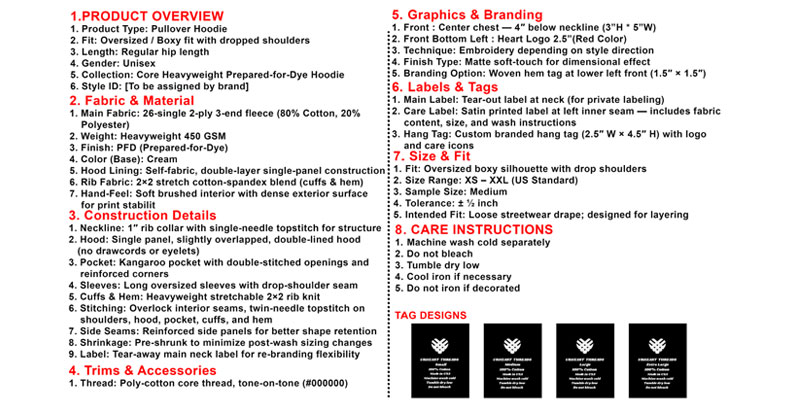
A complete tech pack is not one page.
It is a set of pages, each doing one job.
Here are the eight that matter most for cut-and-sew streetwear.
The order below is also the order they should appear in the document.
01
Flats & callouts
Black-and-white technical drawings from every view, with numbered notes.
02
Bill of materials
Every component the factory must source, from fabric to hangtag.
03
Measurement spec
Every point of measurement is graded across the size range.
04
Tolerances
The agreed pass/fail band for each measurement.
05
Construction
Seam types, machines, stitch types, and stitches per inch.
06
Trims & hardware
Drawcords, eyelets, zippers anything that is not fabric or thread.
07
Colorways
Each color combination, with Pantone references.
08
Labels & packaging
Fibre content, care, origin, and how it ships.
01 · Flats and callouts
Flats are clean, black-and-white line drawings of the garment, drawn flat as if it were laid on a table.
Front, back, and any view that hides detail for a hoodie; that usually means an interior or hood view too.
They are not styled illustrations. They are blueprints. The convention is simple: a solid line is a seam, a dashed line is stitching.
Callouts are the numbered notes that point at specific parts of the flat.
Callout 02 points at the kangaroo pocket and says, “Double top-stitched, bar-tacked at openings.” Each callout removes one decision the factory would otherwise make for you.
The more honest your callouts, the fewer surprises in the sample.
A flat with numbered callouts. Solid lines are seams; dashed lines are stitches.
02 · Bill of materials (BOM)
The BOM is the shopping list.
Every component the factory has to source or supply, line by line: body fabric, rib, hood lining, drawcord, eyelets, sewing thread, main label, care label, and hangtag.
For each one, you name the material, the composition, the weight or size, and the color.
This is the section that most directly drives your quote.
A missing BOM line is a cost the factory either misses or pads for.
Leave the drawcord off, and you will either get the cheapest cord in the building or a follow-up email that delays everything.
Completeness here is what makes competing quotes comparable.
03 · Measurement spec (points of measure)
This is the section that defines fit.
It lists every point of measure, body length, chest width, sleeve length, cuff width, hood height, and so on, against a base size, then grades those values across the full size range.
Measurements are how your sample is judged: the factory measures the sample flat and checks it against this chart.
We build a full example in section 4.
04 · Tolerances
No two garments come off the line identically.
A tolerance is the band of variation you agree to accept on each measurement, for example, plus or minus 1 cm on body length or plus or minus 0.5 cm on shoulders.
Inside the band, the garment passes. Outside it, the garment fails and gets remade.
Tolerances are not a detail to leave for later.
They are the line between “this is fine” and “this is wrong,” and if you do not set them, the factory sets them for you.
Tight tolerances on the measurements that define your silhouette; looser ones where a few millimeters do not change anything.
QUICK RULE
Tighten tolerances on the measurements buyers feel: chest, length, and shoulder. Loosen them on measurements nobody notices: pocket position or label height. Tolerancing everything tightly just raises your reject rate and your price.
05 · Construction and stitch details
This is where a lot of the value of a tech pack lives.
It explains how the garment is assembled.
Which seam joins the shoulder?
Which machine sews it?
What stitch type is used?
How many stitches per inch?
A drop-shoulder hoodie might call for a 4-thread overlock on the side seams and a coverstitch on the cuffs and hem.
You do not need to be an industrial engineer to write this.
You need to be specific about the things that affect look and durability: where seams are taped, where bar tacks reinforce stress points, and how the hood is lined.
The factory fills in the rest with its own machines, and a good one will suggest improvements.
06 · Trims and hardware
Trims are everything that is not the main fabric or the thread: drawcords, eyelets, cord stoppers, zippers, rivets, and woven labels.
For each, specify the finish, the size, and where it goes.
A “metal eyelet” is three different parts depending on whether you mean brass, gunmetal, or nickel, and 5 mm versus 8 mm changes the whole look of a hood.
Hardware is also where cheap substitutions hide.
If you do not name the zipper brand and the eyelet finish, the factory will quote and ship whatever is in stock.
Naming them protects both the price and the product.
07 · Colorways
A colorway is one complete color combination of the garment: body, rib, print, and drawcord together.
Each color in each colorway needs a Pantone reference quoted in a single system.
TCX for cotton is the streetwear standard.
“Black” on its own gets you three different blacks across three dye lots.
A Pantone number gets you the same black every time.
Each colorway pairs body, rib, and print colors with their Pantone references.
This section is part presentation and part law.
In most markets, a garment must carry fabric content, care instructions, and country of origin.
In the US, that includes the rules enforced by the Federal Trade Commission on textile and care labeling; other markets have their own.
Get this wrong, and your shipment can be held at customs.
Packaging covers the rest: main label placement, hangtag, polybag with its suffocation warning, folding, and carton packout.
None of it is glamorous, and all of it gets quoted, so it belongs in the pack.