Why bottoms need their own manual

Bottoms Are the Hardest Thing Most Streetwear Brands Make

A tee has a couple of seams under load. A pair of joggers has a crotch junction, two inseams, two outseams, a waistband, and pockets, all under strain every time someone sits, squats, or takes the stairs.

Bottoms are also sized in two directions: waist and length. That one fact changes your pattern, your grading, your minimums, and your stock planning.

And customers judge bottoms on fit first. A hoodie can run a little big and still sell. A pant with the wrong rise goes straight back.

Most bottom advice skips all of that. This guide doesn’t. Every chapter comes out of running real bottoms production:

The samples that split at the crotch, the elastic that rolled, the leg that twisted after one wash, and the QC calls that saved a drop.

It’s built as a manual, front to back. Foundations come first: styles, fit, fabric, and weight. Then the style-by-style guides, costing, and buyer segments.

From there, it moves into construction, QC, decoration, washes, and trends, and closes with case studies and a full reference section.

Read it in order, or jump straight to the chapter you need. Every guide below is a full walkthrough of one decision.

$4.97 billion

Knitwear exports from Pakistan in FY2025-26, the country’s largest textile export category, are inside total textile exports of $17.93 billion. Sialkot’s cut-and-sew floors sit within that supply base. Source: Profit, citing Pakistan Bureau of Statistics data.


 

How to use this guide?

  • New to bottoms? Start with the style map and foundations, then read the Fit Triangle below. Those decide most of the garment.
  • Costing a run? Jump to Costing, MOQ, and Sourcing, and read a quote line by line before you reply to any factory.
  • Know your style already? Go to the style guides for pants or shorts, nylon, and denim. One silhouette, cut to ship.
  • Fixing a problem? QC and defect troubleshooting name the cause and the prevention for each failure.

The one rule we use on every sample

The Fit Triangle: Why Bottoms Fail as a System

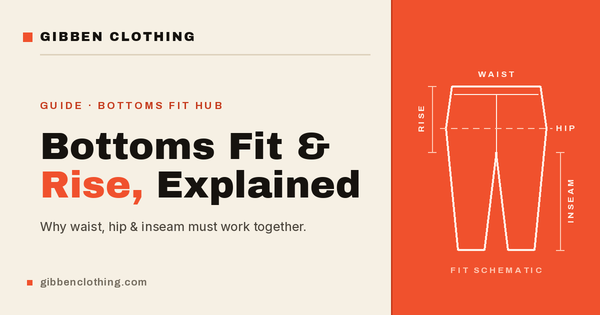
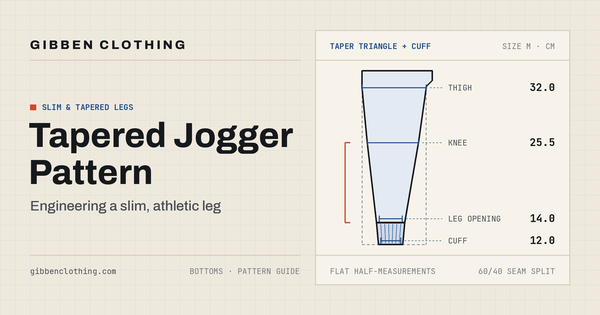
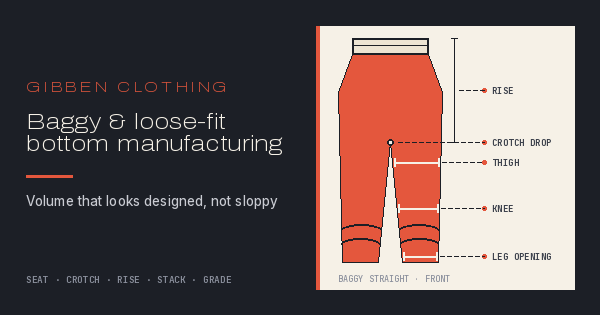
Waist, rise, and inseam are three corners of one triangle. Move one corner and the other two move with it.

Drop the rise, and the waist sits lower on the hip, so it needs more room.

The crotch point moves down, so the inseam shortens, and the thigh gets tighter. Nobody asked for those changes, but they happen anyway.

So we never approve a change to one corner without re-checking the other two on a body.

Three quick checks catch almost every fit problem before bulk:

  1. Sit test. Seated, the back rise shouldn’t pulldown,n and the waistband shouldn’t gap at the back.
  2. Step test. On a high step, the thigh and knee need room. If the seam strains here, the crotch will fail first.
  3. Stand test. Standing, the hem breaks where the spec says, and the side seam runs straight with no twist.
“`html
Jogger pants measurement diagram Technical illustration of jogger pants showing waist, rise, thigh, knee, inseam, outseam, and leg opening measurements. Coral dashed lines connect the waist, rise, and inseam measurement points. A Waist B Rise C Outseam C Thigh D Knee E Leg opening F Inseam Waist Rise Inseam

Points of measure on a standard jogger. The coral triangle links the three points that move together.

“`
Quick reference

Bottoms at a Glance: Style, Fabric, and the Failure to Watch

Every style has a fabric it wants and one failure it tends towards. Use this table to brief a sample, then open the style’s own guide for the detail.

Style Typical base fabric Typical weight Failure to watch
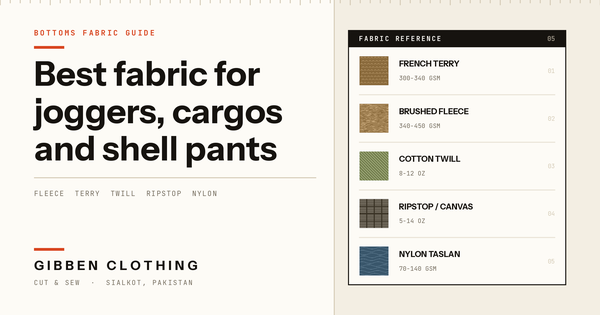
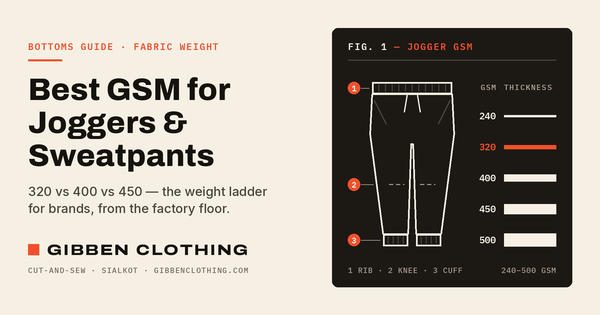
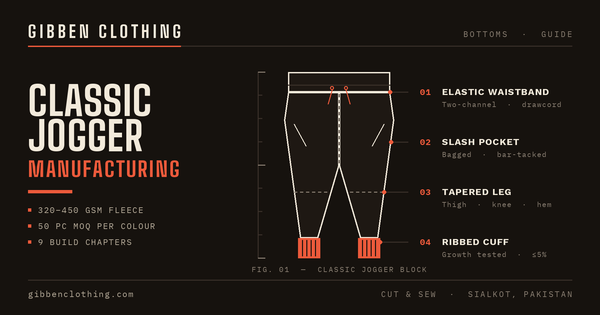
Classic jogger Brushed fleece, French terry 280-380 gsm Cuff rib losing its recovery
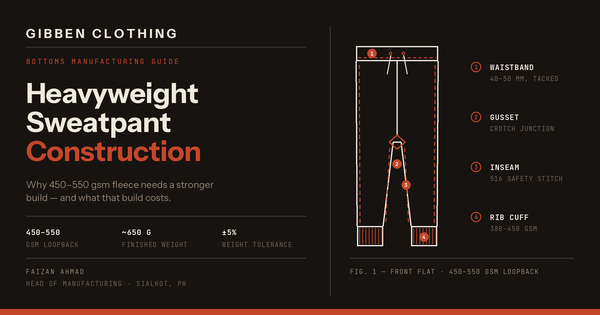
Heavyweight sweatpants Heavy brushed fleece 400-500 gsm Bulky seams at the crotch junction
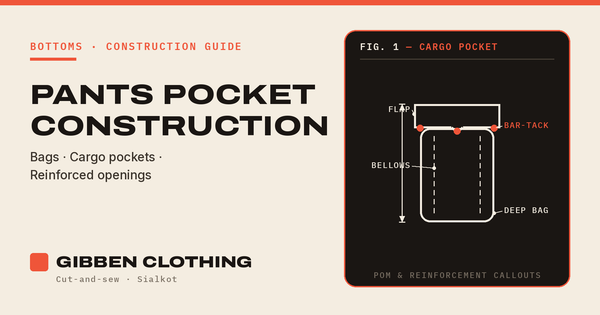
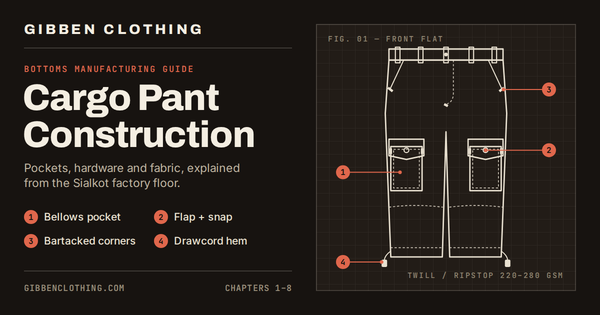
Cargo pant Cotton twill, ripstop 7-10 oz/yd² (approx. 240–340 gsm) Pocket sag and missing bar tacks
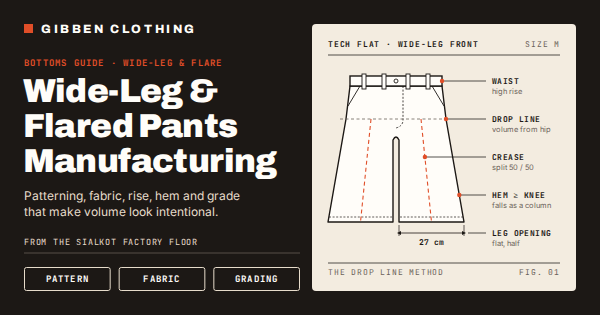
Wide-leg pant Drapey twill, heavy jersey 250-350 gsm Stiff fabric that flares instead of falling
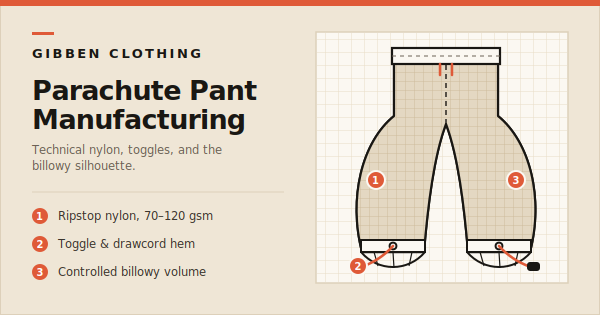
Parachute pants Nylon taslan, nylon ripstop 70-120 gsm Seam slippage, weak toggles
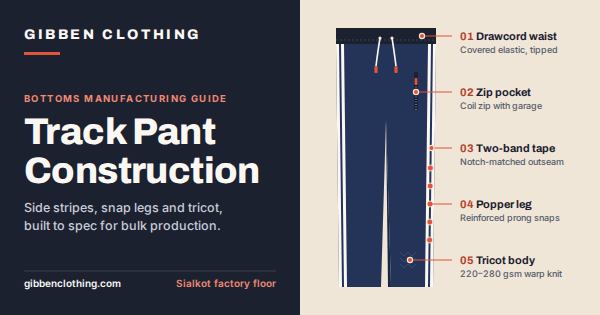
Track pants Poly tricot, nylon shell 180-260 gsm Stripe alignment, snaps pulling out
Mesh shorts Polyester mesh plus liner 120-180 gsm Snagging, liner bunching
Sweat shorts French terry, fleece 260-360 gsm Hem flaring on the big sizes
Biker shorts Nylon or poly with elastane 200-280 gsm Opacity, gusset comfort
Jeans Rigid or stretch denim 12-16 oz/yd² Shrinkage and leg twist after washing
Leggings Nylon or poly with elastane 220-300 gsm Turning see-through when stretched

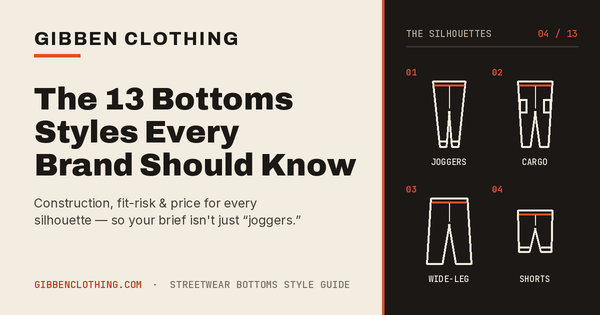
Style Map, Fit and Fabric Foundations:

Every pair of bottoms is decided in three places before a sample exists. The silhouette. The fit block. The fabric.

Get those right, and most production problems never show up. Get them wrong, and no amount of QC rescues the run.

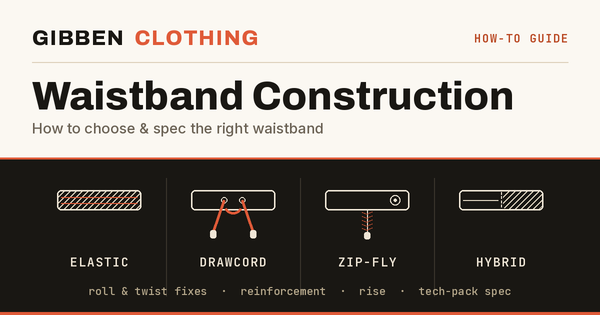
These eight chapters are the base layer. They map the styles, explain how the waist, rise,, and inseam lock together, and show how the waistband, crotch, and pockets are really built. Read them before you brief a pattern maker.

Bottoms Manufacturing Questions

Every guide here comes out of our own cut-and-sew floor in Sialkot, Pakistan. We run the sampling, the sewing, and the QC in-house rather than brokering it out. That’s why the advice is about what happens on real machines, not what a catalogue says.

It depends on the fabric, the number of colors, the size range, and the build. That’s exactly why MOQ gets its own chapter. As a starting point, our low-MOQ program runs from 50 units per style. Remember that bottoms split across waist and length sizes, so the per-size quantity matters as much as the total.

Yes. Fleece and French terry joggers, sweatpants, and sweat shorts are knit. Cargos, trousers, nylon shells, and ripstop builds are woven.

The knit vs. woven chapter explains why the choice changes the pattern, the seams, and the cost.

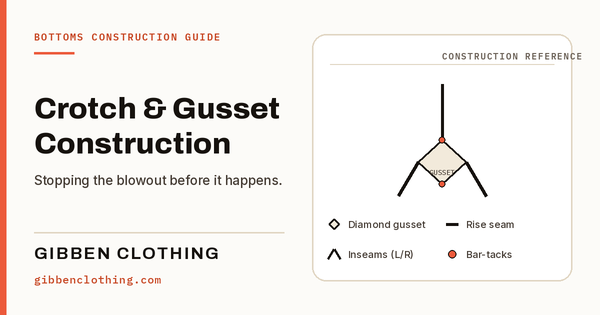
Crotch blowouts usually come from three things together: a rise that’s too short, a stitch that can’t stretch with the fabric, and no reinforcement where four seams meet.

The fix is in the pattern, the stitch choice, and the reinforcement at the crotch junction. The crotch construction and crotch blowout chapters walk through each one.

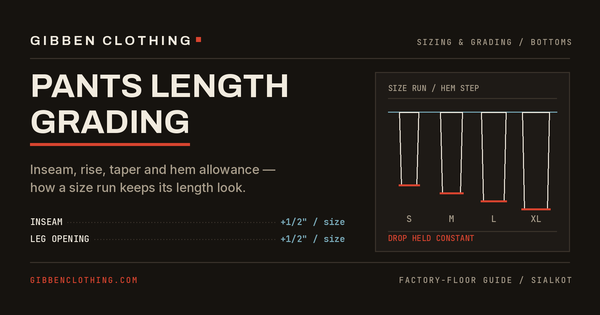
Tops are mostly sized in one direction. Bottoms are sized in two: waist and length. Rise, thigh, and leg openings all have to follow along.

That’s why we treat waist, rise, and inseam as one system, and why bottoms need more care in grading and stock planning.

Yes. Our sampling process can develop a pair of bottoms from a reference garment or a sketch.

The sizing chapters show how to build a waist-by-inseam chart, and our size guide gives you a starting block to work from.

From approved sample to shippable units, expect a realistic window rather than one number.

Fabric lead time, washes, decoration, and QC all sit inside it. The lead-time chapter breaks the timeline down stage by stage.

On the floor · Sialkot

Written by

Faizan Ahmad

Chief Apparel Technologist & Head of Manufacturing, Gibben Clothing · Sialkot, Pakistan

Faizan leads production at Gibben Clothing, a cut-and-sew streetwear manufacturer in Sialkot, with 8+ years turning raw yarn into retail-ready hoodies, tees, bottoms, jackets, tracksuits, and headwear. He doesn’t just write about clothing; he works the floor, so every guide here is grounded in real fabric behavior, QC standards, and production data from live runs.