

Two hoodies can sit side by side, look almost identical on a hanger, and feel like they came from different planets the moment you put them on.

The difference is rarely the print. It’s the fabric.

Fabric is where most streetwear brands quietly win or lose.

It decides how a piece drapes, how warm it is, how it ages after twenty washes, and more than anything, whether a customer believes your price tag the second they touch it.

The problem is that fabric is confusing on purpose.

The same base cloth gets sold under a dozen names. “Fleece,” “French terry,” “loopback,” and “sweat” are thrown around as if they’re interchangeable, and they aren’t.

GSM numbers get quoted with no context.

A mill sends a swatch that feels great and a bulk run that feels like a moving blanket.

This guide fixes that.

It gives you one repeatable way to read any streetwear fabric and then walks through the fabrics, what they are, how they behave, and when to reach for each.

By the end, you’ll be able to write a fabric spec a factory can’t fudge.
Chapter 01 · The framework

How to read a fabric: the Four-Lens Read

Before any fabric name, learn the four things that actually decide how a cloth behaves.

Every swatch you ever touch can be read through these four lenses.

Get them in this order, and fabric stops being a guessing game.

01

Fabric:

It’s made of cotton, polyester, elastane, or a blend. Fiber sets the baseline: softness, breathability, durability, and stretch.

02

Construction:

How the yarn is knit: jersey, French terry, loopback, or brushed fleece. Construction decides structure, surface, and warmth.

03

Weight:

How heavy it is in GSM. Weight drives drape, structure, and season, but more is not automatically better.

04

Finish:

What’s done after knitting: brushing, peaching, enzyme wash, and garment dye. Finishing is where cheap and premium part ways.

Why the order matters:

Most brands argue about GSM first.

That’s lens three. If you start there, you’ll buy a heavy fabric that still feels cheap, because fabric and finish lenses one and four are where hand-feel really lives.

Read every spec the same way, top to bottom.

Fabric tells you the raw character.

Construction tells you what it’ll look and behave like.

Weight tells you the season and structure.

The finish tells you how premium it’ll feel in the hand.

Four lenses, one fabric, no surprises in the bulk run.

Knit, not woven

Almost everything in this guide is a knit yarn looped into a stretchy, soft cloth (jersey, terry, or fleece). Wovens (twill, canvas, and ripstop) are interlaced threads: stiffer, with no stretch, and used for jackets, shells, and bottoms. Streetwear tops live almost entirely in the knit world, so that’s where we’ll stay.

Chapter 02 · The lineup

The core streetwear fabrics and how each behaves:

You don’t need to know forty fabrics.

You need to know the six or seven that do almost all the work in streetwear and what each one is good and bad at.

Here’s the working lineup.

Fabric What it is Feels like Best for
Single jersey Light knit, smooth on one side, used for tees Light, breathable, drapey T-shirts, light long sleeves, inner layers
French terry Knit with unbrushed loops on the inside, flat face outside Soft, springy, breathable, not fuzzy Spring/fall hoodies, crewnecks, joggers, shorts
Loopback The construction is French terry uncut loops on the reverse Textured inside, clean outside Year-round sweats with a lighter, cleaner hand
Brushed-back fleece French terry with the inner loops brushed into a soft nap Warm, fuzzy inside, cozy Standard & heavyweight hoodies, winter sweats
Waffle / thermal Knit with a raised grid texture that traps air Textured, stretchy, insulating for its weight Layering tops, henleys, transitional pieces
Rib knit Vertical-channel knit with strong stretch and recovery Stretchy, hugging, springs back Cuffs, hems, collars, fitted tops
Twill/canvas (woven) Interlaced woven cloth, no stretch Structured, sturdy, crisp Overshirts, workwear jackets, bottoms

The behavior above is directional. The exact hand depends on fabric, yarn, and finish, which is the whole point of the Four-Lens Read.

Notice that three of those French terry, loopback, and brushed fleece are really the same family at different stages. That confusion costs brands real money, so it gets its own chapter next.

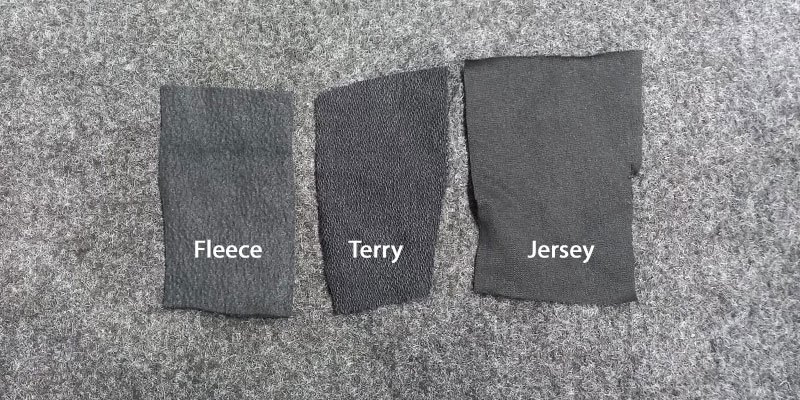
Side by side terry, fleece and jersey swatches
Chapter 03 · The big confusion

French terry vs loopback vs brushed fleece:

This is the question we get most, and the one most brands get wrong.

The short version: they are the same cloth at three stages of finishing.

Understand the chain, and you’ll never confuse them again.

Start

Jersey base:

A plain knit. Smooth, light, no loops. This is the raw starting cloth.

Add loops

Loopback / French terry:

Extra yarn is knit into uncut loops on the inside. Outside stays flat; inside is looped and textured.

Brush the loops

Brushed-back fleece:

Those inner loops are mechanically brushed open into a soft, warm nap. That’s the cozy inside of a classic hoodie.

French terry and loopback:

“Loopback” describes the construction: a knit with uncut loops on the reverse face.

“French terry” is the name almost everyone uses for that fabric in finished garments.

In practice, the two words point at the same cloth: flat outside, looped inside, and unbrushed.

Because the loops are left intact, French terry stays breathable and relatively light.

It has a clean, slightly springy hand.

It’s the right call when you want a hoodie or crewneck that wears year-round without cooking the wearer and when you want a crisp outer face to print or embroider on.

Some mills use “loopback” to mean a slightly lighter, cleaner-looking version and “French terry” for a fuller one.

There’s no universal rule, which is exactly why you spec by construction and GSM, not by name alone.

Brushed-back fleece:

Take that same loopback cloth and run the inside across rollers that tear the loops open into fuzz. Now it’s fleece.

The nap traps air, so it’s noticeably warmer and softer against the skin.

This is what most people picture when they think “hoodie inside.”

The trade-offs are real. Brushing makes fabric warmer and cozier, but it also:

What brushing adds

  • Warmth: the nap traps body heat
  • Softness, plush, cushioned inside
  • Perceived comfort: the “want to live in it” feel
  • A visual loft looks fuller and more substantial

What does brushing cost?

  • Breathability runs hotter; less for warm seasons
  • Pilling risk: loose surface fibers can ball up if the fiber is short or cheap
  • Weighted: brushed fleece usually sits heavier
  • Print surface: a fuzzy inside doesn’t matter, but heavy nap changes how the outer face takes detail

The one-line rule

French terry = breathable, lighter, year-round, and clean-hand.

Brushed fleece is warmer, heavier, cozier, and perfect for winter. Same family, different finish.

Pick by season and feel, then lock the GSM.

Chapter 04 · Lens one, up close

Cotton vs. polyester vs. blends: when to use which?

Construction decides the cloth’s shape.

Fabric decides its soul.

The same French terry in 100% cotton versus a poly blend will feel, breathe, and age completely differently.

Here’s how to choose.

Cotton is the streetwear default:

Cotton is soft, breathable, takes dye beautifully, and has the natural hand customers associate with quality.

It’s the right baseline for most premium streetwear.

But not all cotton is equal, and the yarn type matters more than most brands realize:

Ring-spun
 

Yarn twisted to be smoother and stronger. Softer hand, less pilling, more durable. The default for premium.

Combed
 

Short fibers and impurities are combed out before spinning. Even smoother and cleaner, often paired with ring-spun.

Carded / open-end

Cheaper, faster, rougher. More short fibers are left in, so it pills sooner. Where “cheap feel” often starts.

Cotton’s weaknesses: it shrinks (unless pre-shrunk/compacted), wrinkles, dries slowly, and can lose shape over time if the construction is weak. Good finishing solves most of this, which is why finish is lens four.

Polyester performance and price:

Polyester is durable, wrinkle- and shrink-resistant, dries fast, and holds its shape.

It wicks moisture, which makes it useful for athletic and technical pieces.

It’s also cheaper, which is why budget garments lean on it.

The downside is hand and breathability.

High-polyester fabrics can feel plasticky or slick, run hot, hold odor, and build static.

Used badly, polyester is the fastest route to a garment that looks fine and feels cheap.

Used well as recycled polyester (rPET) in a smart blend, it adds durability and a sustainability story without wrecking the hand.

Blends the practical middle:

Most real-world streetwear is a blend, because blends let you tune the trade-offs:

Blend What you get Reach for it when
Cotton/poly (e.g., 80/20) Most of cotton’s hand, plus durability, less shrinkage, and lower cost You want a reliable everyday hoodie at a workable price.
50/50 cotton/poly Durable, shape-stable, budget-friendly, slightly synthetic hand Volume programs where cost and consistency lead
Tri-blend (cotton/poly/rayon) Very soft, drapey, lightweight, vintage/worn-in feel Fashion-forward, slouchy, premium-soft pieces
+ Elastane/spandex (2–5%) Stretch and recovery hold shape, hugs the body Fitted silhouettes, rib trims, anything that must spring back

Rule of thumb

Lead with cotton (ring-spun) for hand and premium positioning. Add polyester for durability, shape, and price. Add elastane for stretch and recovery. Choose the blend whose trade-off your customer will notice first.

Chapter 05 · Lens three, up close

GSM and weight: choosing the right weight

GSM means grams per square meter, literally how much a one-square-meter square of the fabric weighs.

It’s the single most quoted fabric number and the most misunderstood.

Higher GSM means more material, more warmth, and more structure.

It does not automatically mean better.

Here are the working weight bands for streetwear knits.

Treat these as orientation, not law; fiber and construction shift the feel at any given weight.

Band Typical GSM Feels like Used for
Lightweight ~200–280 GSM Soft, drapey, breathable, packable Summer hoodies, light crews, layering, joggers
Midweight ~280–380 GSM Substantial but wearable year-round The standard hoodie sweet spot
Heavyweight ~380–500+ GSM Dense, structured, holds its shape, premium heft Premium & winter hoodies, statement pieces

Weight is a feel decision, not a quality score:

A 220 GSM French terry crewneck and a 450 GSM brushed fleece hoodie are both correct for different products.

A light summer piece in heavyweight fleece is a mistake, not an upgrade.

The skill is matching weight to the job.

Two things weight controls that customers feel immediately:

  • Drape vs. structure. Lighter fabric drapes and moves; heavier fabric stands up and holds a boxy, structured silhouette. Your fit intent should pick the weight, not the other way around.
  • Perceived value. Heft reads as quality up to a point. Past that, a hoodie gets stiff, hot, and boardy, and “premium heavy” tips into “uncomfortable.” Density and finish matter more than chasing a bigger number.

Watch the tolerance:

GSM is quoted with a tolerance; a swatch at 380 might bulk-run at 350. Always spec your target GSM and the acceptable +/- range in writing, and approve a physical sample at the real weight. This single line in a spec prevents most “the bulk feels thinner than the sample” complaints.

Chapter 06 · The margin chapter

Why “cheap feel” kills brands at premium price points:

A customer decides whether your price is fair in the first three seconds of touching the garment, long before they read a care label or a fiber breakdown.

If the fabric feels cheap, the price feels like a lie, and the return follows.

At premium price points, hand-feel is the product.

The cruel part: a hoodie can have the right fiber, the right construction, and a respectable GSM and still feel cheap, because the tells live in the details. Here are the ones that give a garment away.

  1. Thin, papery hand: low-density or low-GSM cloth that you can see light through. It signals “blank,” not “brand,” no matter what you charge.

  2. Plasticky or slick surface: Too much low-grade polyester gives a synthetic sheen and a slippery hand. Customers read it instantly as cheap.

  3. Fast pilling: Little fiber balls after a few wears. The usual culprit is carded / open-end cotton or short-staple fiber, a fiber-and-finish problem, not bad luck.

  4. Dead recovery: Cuffs and hems that stretch out and never spring back. Weak rib or no elastane means the garment looks tired after one wash.

  5. Rough, dry hand: Uncombed cotton or a missing softening finish leaves the cloth scratchy. The fix is yarn quality and finishing lenses one and four.

  6. Inconsistent color: patchy dye, fast fading, or a bulk run that doesn’t match the sample. Reads as low control and erodes trust in everything else.

What premium fabric does instead:

Flip every detail, and you get the signals that justify a premium price: a dense knit with real cover, ring-spun or combed cotton, and an honest GSM you can feel.

A soft brushed or peached finish, strong recovery in the rib, and a clean, consistent surface that looks the same on garment number one and garment number one thousand.

None of that is exotic.

It’s the boring discipline of choosing better yarn, a tighter knit, and the right finish and then controlling the bulk run so it matches the sample.

That discipline is the whole reason cut-and-sew exists: you’re buying control over exactly these details instead of inheriting whatever a stock blank happened to use.

The bottom line

You can’t out-design a cheap-feeling fabric. Spend the money on one lens upgrade: better fabric, denser construction, proper finish, and the price stops feeling like a stretch. Hand-feel is the cheapest marketing you’ll ever buy.

Are deciding whether stock blanks are capping your fabric quality? Our blank vs custom cut-and-sew guide maps that exact jump.

Chapter 07 · Putting it together

Matching fabric to product and season:

Now run the four-lens read in reverse:

Start from the product and the season, and let them point you to the fabric.

Here’s the cheat sheet we use.

By product:

Product Go-to fabric Typical weight
T-shirt Single jersey, ring-spun cotton ~140–200 GSM
Lightweight hoodie/crew French terry ~280–340 GSM
Standard hoodie Brushed-back fleece ~320–400 GSM
Heavyweight/premium hoodie Brushed fleece, ring-spun, or cotton-rich ~400–500+ GSM
Joggers/sweatpants French terry or midweight fleece ~280–360 GSM
Shorts Lighter French terry ~240–300 GSM
Performance / athletic Poly-rich blend, moisture-wicking Varies by build

By season

Warm seasons

Lean, light, and breathable: lighter French terry, jersey, and breathable blends. Skip heavy brushed fleece it runs hot and stalls in summer drops. Unbrushed loopback keeps the sweat look without the heat.

Cold seasons

Lean, warm, and substantial: midweight to heavyweight brushed fleece, cotton-rich for hand, and denser knits. This is where heft genuinely earns its place, and customers expect it.

The mistake to avoid is a one-fabric brand running every product on the same heavyweight fleece because it feels “premium.” A summer tee in winter fleece isn’t premium; it’s wrong for the job. Match the fabric to what the piece has to do.

Chapter 08 · The handover

What to spec with your manufacturer:

Here’s where it all becomes real. A fabric name alone, “French terry, heavy,” gives a factory room to send you whatever’s cheapest to source.

Specify it properly, and you get the exact cloth you approved.

Run down this list for every fabric, every program.

  • Fiber composition + yarn type. The exact percentages (e.g., 100% cotton, 80/20, +5% elastane) and the yarn are ring-spun, combed, or carded. Yarn type is where hand quietly lives.

  • Construction. French terry, loopback, brushed-back fleece, or jersey name it explicitly so “fleece” can’t quietly become unbrushed terry, or vice versa.

  • Target GSM + tolerance. The weight you want and the acceptable +/- range. Don’t leave tolerance blank; that gap is where bulk feels thinner than the sample.

  • Finish. Brushed or unbrushed, peached, enzyme-washed, or garment-dyed, every after-treatment that changes the hand or look.

  • Shrinkage tolerance. Maximum acceptable shrinkage, and whether the fabric is pre-shrunk / compacted. This protects your fit after the customer’s first wash.

  • Dye method. Piece-dye, yarn-dye, or garment-dyeing changes color depth, consistency, and the worn-in look you’ll get.

  • Rib spec for trims. Cuff, hem, and collar rib: the rib gauge (e.g., 2×1, 2×2) and elastane content. A weak rib is a top cause of “looking tired after one wash.”

  • Physical hand approval. Approve an actual swatch or lab dip at the real bulk weight; never sign off on a fabric you’ve only seen in a photo or quote.

  • Test standards. Agree on pilling and colorfastness standards up front so “acceptable” isn’t decided after the bulk is already knit.

If you remember one thing

Spec by fabric + yarn + construction + GSM + finish, never by name alone. A name is a category; a spec is a contract. The Four-Lens Read is literally the spec sheet.

Before a factory will run a custom fabric, you’ll also want a tech pack, target quantities, and a reference sample ready.

Frequently asked questions

For a premium hoodie, most brands land on brushed-back fleece in ring-spun cotton or a cotton-rich blend, in a midweight-to-heavyweight GSM.

Ring-spun (or combed) cotton gives the soft, durable hand customers associate with quality; brushing adds warmth and a cozy inside; the right weight adds structure and heft.

But “best” depends on the season and silhouette; a year-round or warm-weather premium piece is often better in unbrushed French terry.

Match fabric, construction, weight, and finish to the job rather than defaulting to the heaviest option.

They’re the same family at different finishing stages, not the same fabric.

French terry has unbrushed loops on the inside, is breathable and lighter, and has a clean hand.

Brushed-back fleece is French terry with those inner loops brushed into a soft, warm nap.

So fleece is warmer and cozier; French terry is more breathable and year-round.

“Loopback” usually refers to the same unbrushed terry construction.

Because the names overlap, always confirm whether a fabric is brushed or unbrushed in your spec.

As a rough guide: ~280-380 GSM is the year-round midweight sweet spot, ~200-280 GSM suits lighter and warm-weather pieces, and ~380-500+ GSM gives a heavyweight, structured, premium feel for winter and statement hoodies.

Higher GSM isn’t automatically better; past a point, a hoodie gets stiff and hot.

Pick the weight from the fit and season you want, then confirm a physical sample at the real bulk weight with a stated tolerance.

It depends on what your customer notices first. Cotton wins on hand feel, breathability, and premium positioning but shrinks and wrinkles more.

Polyester wins on durability, shape retention, fast drying, and price, and adds moisture-wicking for athletic pieces, but too much can feel synthetic.

Most real-world streetwear uses a blend: cotton for hand, polyester for durability and cost, and a little elastane for stretch and recovery.

Lead with ring-spun cotton for premium feel; add the others to fix specific trade-offs.

Pilling small fiber balls on the surface usually comes from short-staple or low-grade yarn, most often carded / open-end cotton, and from heavy surface brushing on a weak base.

The fixes are at the fiber and finish level: move to ring-spun or combed cotton, choose a denser knit at an honest GSM, control the brushing, and agree on a pilling test standard with your factory before bulk.

Pilling is a spec problem, not bad luck; it’s preventable upstream.

Specify it by the four lenses, in writing: fiber composition and yarn type (e.g., 100% ring-spun cotton), construction (French terry, loopback, brushed fleece, jersey), target GSM with tolerance, and finish (brushed, peached, garment-dyed, and so on).

Add shrinkage tolerance, dye method, rib spec for trims, and the pilling/colorfastness standards you’ll test against.

Then approve a physical swatch at the real bulk weight; never sign off from a photo.

A name is a category; this list is a contract.

From the manual

This is one chapter of The Complete Streetwear Manufacturing Guide

These chapters cover taking a streetwear brand from idea to shipped units, costing, sourcing, tech packs, QC, freight, and launch. All written from the Sialkot factory floor.

Open The Full Guide

On the floor · Sialkot

Written by

Faizan Ahmad

Chief Apparel Technologist & Head of Manufacturing, Gibben Clothing · Sialkot, Pakistan

Faizan leads production at Gibben Clothing, a cut-and-sew streetwear manufacturer in Sialkot, with 8+ years turning raw yarn into retail-ready hoodies, tees, bottoms, jackets, tracksuits, and headwear. He doesn’t just write about clothing; he works the floor, so every guide here is grounded in real fabric behavior, QC standards, and production data from live runs.