GOES UP WITH SMALL BATCHES
Cost per unit
Fixed setup is spread across fewer pieces. Each garment costs more to make.
GOES UP WITH BULK
Cash at risk
More money committed before a single piece sells. Bigger downside if it doesn’t.


Fixed setup is spread across fewer pieces. Each garment costs more to make.
More money committed before a single piece sells. Bigger downside if it doesn’t.
Almost every brand we work with hits the same wall at the same moment.
The sample looks right.
The fit is dialled in.
The fabric is approved.
Then comes the only question that actually costs money:
How many do we make?
It feels like a math problem. It isn’t.
It’s a bet on demand, and, like any bet, the right size depends on how confident you are, not on what the factory’s minimum is.
This guide gives you a straight way to make that bet.
No “it depends,” no pushing you toward whatever quantity suits us.
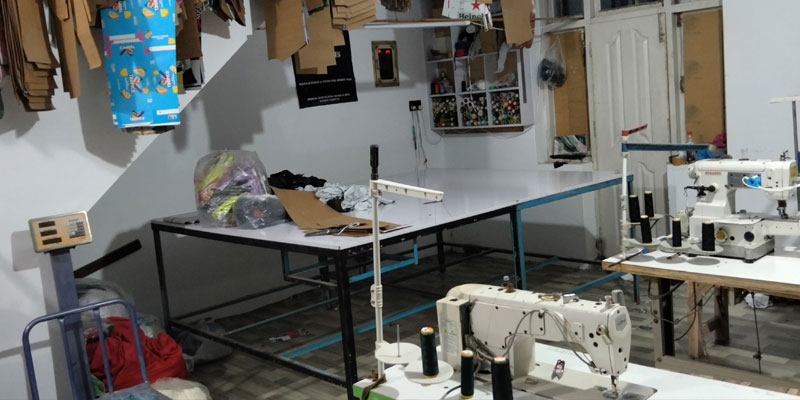
We run a cut-and-sew floor at Sialkot GIBBEN CLOTHING, so we see what happens after the order is placed: the runs that sell through, the ones that sit, and the reorders that fix both.
We’ll show you the trade-off behind the decision, which side wins, and a simple scale to place your own drop on.
The trade-off underneath everything
Two numbers decide this. They pull in opposite directions, so you can’t win on both at once.
When brands ask whether small batches are “expensive,” they usually mean one thing: why does each piece cost more than a big run?
Fair question. But it’s only half the picture.
Cost in manufacturing lives on two levels, and you have to look at both.
Most of what a production run costs is fixed before a single garment is sewn.
Marker making.
Machine setup.
And dye lots cost roughly the same whether we cut 80 pieces or 800.
Spread that fixed cost across more units, and the price per piece drops.
Spread it across fewer, and it climbs.
That’s economies of scale, and it’s why a 50-piece run will always carry a higher per-unit price than a 1,000-piece run of the same style.
GIBBEN CLOTHING tiers
A custom heavyweight hoodie might land near $52/unit at 50 pieces, around $46/unit at 500, and close to $40/unit at 1,500.
The curve is steepest at the low end and flattens as volume grows.
This is the number most brands forget, and it’s the one that closes companies.
Cash at risk is the total money committed before you’ve sold anything, your whole exposure, if the drop doesn’t move.
Here’s the twist: Small anything raises your per-unit cost but slashes your total exposure.
Bulk does the reverse. You pay less per piece, but you’ve staked far more on a single guess.
two runs, total exposure
50 units at $52 = $2,600 at risk. 1,500 units at $40 = $60,000 at risk. The big run is cheaper per piece.
So the decision isn’t “Which is cheaper?”
It’s “Which risk can you afford right now?
A thinner margin on a safe quantity or a fat margin on a bet you can’t easily reverse?
A useful reframe we give every new brand: forget the factory’s minimum for a second and work out your true minimum.
The most you can comfortably risk on one untested style.
If you can stomach losing $2,600 on a test, and your landed cost is $52 a unit, your practical run is about 50 pieces.
Whatever a factory’s stated MOQ says.
Start from the cash you’re willing to lose, then see which production mode fits inside it.
Demand confidence tells you how far you can safely stretch that number, and we’ll get to exactly how to read it below.
Setting the terms
There’s no official line. But the trade uses rough bands, and knowing them keeps the conversation honest.
Nobody owns these words, so a “small batch” to one factory is a rounding error to another.
Still, the industry settles into rough territory worth knowing.
Generally treated as anything under ~500 units per style.
In cut-and-sew, real small-batch floors often start around 50-100 pieces per style and colorway.
Hundreds to thousands of units per style run continuously on dedicated line time.
Orders above ~5,000 units are usually called high volume.
Built for proven sellers and wholesale.
Your run size isn’t only about our setup.
It’s often set by the mill.
Fabric suppliers carry their own minimums, frequently 500-1,000 meters, or 50-100 kg, per color.
Order a custom-knit fleece in one colorway, and you may need to cut enough garments to justify a whole dye lot.
This is why stock fabrics and shared-base cloths unlock lower minimums, while custom-milled fabric, specialty knits, and multiple colorways push your floor up.
If you want a genuinely small first run, the fabric choice matters as much as the quantity.
Quick note on MOQ types
When any factory quotes an MOQ, ask the question that prevents nasty surprises:
Is that per style, per color, or per size?
A “300-piece minimum” split across three colorways is a very different commitment than 300 of one.
Check our MOQ guide to learn more about this topic.
The case for going small
Small batch isn’t the cheap option; it’s the risk management option.
It’s right far more often than new brands expect.
The whole point of a small run is to buy information instead of inventory.
You’re not trying to win on margin yet.
You’re trying to learn what sells before you bet on it.
These are the moments small batch is the smarter call.
Launching 500 units of something the market hasn’t validated is a far more painful mistake than proving demand with 100 and building from there.
A small run lets the market vote with real money before you scale.
Scarcity is the product.
A capsule, a collab, a seasonal colorway these are meant to sell out.
A tight run protects the “limited” promise and keeps you from sitting on last season’s idea.
First samples are rarely perfect; it usually takes two to three sampling rounds to reach a production-ready piece.
A small first run is the real-world test after sampling the one that tells you whether the fit lands at scale.
For a young brand, the savings of bulk come at the cost of tying up funds in stock that may not move.
Poor inventory management is a leading reason brands fail.
Small batches keep your cash liquid and your options open.
Small runs let you chase trends, try colorways, and react when something doesn’t land without a warehouse full of a decision you’ve outgrown.
Honest caveat
Small runs carry trade-offs beyond price: less negotiating power, sometimes longer waits behind bigger clients, and slightly higher defect rates because operators switch between styles more often. It’s worth it for the information, but go in with eyes open. See our guide on inspection and AQL.
The case for scaling up
Once a style is proven, staying small is leaving money on the table.
Bulk is how a winner becomes a margin.
Bulk isn’t the “default grown-up” choice; it’s the reward for having data.
When you already know a style sells, volume stops being a risk and becomes a lever.
Here’s when to pull it.
It’s sold through before, ideally more than once.
Demand is no longer a guess.
Now the goal flips from learning to earning, and the lower per-unit cost goes straight to your margin.
Stockists need depth across sizes and reliable reorders.
Wholesale margins are thinner, so the per-unit savings of bulk aren’t optional; they’re what makes the channel work.
If you’re competing on price, or you simply want healthier unit economics on a core line, volume is the cleanest way to get there.
The fixed costs are the same; spreading them wider is free money.
One big run from one dye lot gives you the tightest color and quality match.
Repeated small runs risk visible variation between batches, different deadstock rolls, and slightly different shades.
For a core product customers reorder, consistency is the brand.
Accurate forecasting is the single biggest lever for a good bulk outcome.
When we know what you need and when, we schedule line time, lock fabric, and often improve your pricing.
Predictability earns better terms.
The framework · GIBBEN CLOTHING
Order size shouldn’t track the factory’s minimum.
It should track how sure you are.
This scale matches the two.
Every run is a bet on demand.
So the cleanest way to size one is to ask how strong your evidence is, then let your confidence, not your optimism, choose the quantity.
We map four tiers.
Find where your style honestly sits today, and read across to the run that fits.
A new idea with no sales history. A hunch, a mood board, a design you love. Zero market evidence yet.
Run size
Sample → micro-batch
Soft proof: a waitlist, pre-orders, strong saves/shares, or paid-ad interest on sample photography. People want it; you just haven’t shipped it.
Run size
Small test batch
It has sold through at least once at a price that works. Real revenue, real fit feedback, a clear sense of size curve.
Run size
First true production run
Repeat sell-through. Predictable reorder velocity. A core style you’d be foolish not to keep in stock. Demand is no longer a question.
Run size
Bulk lock in margin
The discipline is honesty about which tier you’re really on.
Most brands feel like they’re a tier higher than the evidence supports; that optimism is exactly what fills warehouses.
If you can’t point to the signal, you’re not on that tier yet.
How to use it
Place the style, not the brand. A two-year-old label launching a brand-new silhouette is back at Tier 1 for that piece, even if its bestseller is firmly Tier 4. Score each style on its own evidence.
From gut feel to evidence
The hard part is gathering a signal when there’s nothing to show shoppers yet.
Here’s how to manufacture evidence before you manufacture stock.
Tier 1 feels stuck: how do you get proof for something that doesn’t exist?
You build cheap tests that generate real signal.
Each one moves you up the scale without committing to a full run.
You don’t need inventory to gauge interest; you need imagery.
Shoot one sample garment, generate on-model photography from it, and put it to work:
The rule that keeps you honest
Size the run to the evidence in front of you, not the outcome you’re hoping for. If the only proof is “I really believe in this,” you’re on Tier 1, and Tier 1 means a test, not a bulk order. Belief is necessary. It just isn’t evidence.
Pair this with your true minimum from earlier, the cash you can safely risk.
Your tier tells you how far to stretch; your cash-at-risk ceiling tells you where to stop.
The right run sits where those two agree.
Bridging the two
You don’t have to choose small or bulk for good.
The smartest brands climb each reorder bigger than the last, as sell-through earns the right to scale.
Treat small-batch and bulk as the bottom and top of a staircase, not a one-time fork in the road.
You start small to learn, then step up each reorder as the evidence grows.
Cost per unit falls as you climb; risk stays tied to what you’ve actually proven.
The Staircase Reorder in Motion
Step 1: Test (Tier 1→2). A small first run proves the design in the real world. You learn the size curve, the true sell-through, and the fit feedback. The higher per-unit cost is the tuition fee.
Step 2: Confirm (Tier 3). It sold. You reorder large enough to hit a better price tier and meet the demand you’ve now measured, not imagined. Per-unit cost drops; risk is backed by data.
Step 3: Scale (Tier 4). Reorder velocity is steady. Now you commit to bulk on a core style, lock a single dye lot for consistency, and bank the margin. The bet is no longer a bet.
Reorders are cheaper to run than first orders.
The hard part, sourcing, development, sampling, and ironing out the pattern, is already done.
Some fixed costs remain, but a proven, stable-spec reorder often prices better than its first run, even at similar volume.
It also builds the relationship.
Factories are more flexible with brands that show commitment: repeat orders, clear forecasts, and on-time payment.
A letter of intent promising reorders if the first batch sells can unlock a lower first-run minimum, because it lowers our risk on the one-off.
Show the staircase, and the terms tend to follow you up it.
Phased runs only work if batch two matches batch one.
That means locking your specs early: fabric, trims, and color standards, and ideally reserving fabric so later steps pull from a compatible lot.
A partner using random deadstock for each small run will never give you consistency between samples, bulk, and reorders, and customers notice.
Plan the staircase with repeatability built in. A locked tech pack is what makes this possible.
Beyond price
Per-unit cost is the headline, but four other things shift with run size.
Plan for them, and there are no surprises.
Bulk needs dedicated line time, so it’s scheduled, and large orders run continuously once they start.
Small orders can sometimes wait behind bigger clients.
Either way, build in the sampling rounds up front: it commonly takes two to three rounds to reach a production-ready piece, and skipping them only resets the clock later.
Whatever the run size, a new style needs the same front-end work: a detailed tech pack, a fit sample, a pre-production sample for final sign-off, and lab dips to approve exact colors.
Mid-process changes this and resets the timeline.
Get the inputs right, and both small and bulk runs move faster.
Factories follow instructions, not intentions.
In a big run, operators stay on one style, and the process stabilizes; cutting, stitching, and finishing all tighten up.
In a 50-100 piece run, operators switch between styles more, so small batches tend to carry slightly higher variability.
And the math of defects hurts more at a small scale: ten flawed pieces out of 100 is a 10% loss; out of 1,000 it’s absorbed.
Volume is leverage.
Larger and repeat orders earn better pricing, priority scheduling, and more flexible terms.
Small one-offs carry less weight, which is exactly why the Staircase Reorder and a clear growth plan matter: they turn a small brand into one a factory wants to grow with.
See our guide on how to negotiate with a clothing factory.
The at-a-glance answer
Everything above, compressed into one table. Read down the column that matches your tier.
| Factor | Small batch | Bulk |
|---|---|---|
| Cost per unit |
Higher Fixed setup spread across fewer pieces |
Lower Economies of scale kick in. |
| Cash at risk |
Low Small, known downside |
High Large, harder-to-reverse commitment |
| Typical run size |
~50-500 per style Fabric minimums permitting. |
Hundreds to thousands High volume above ~5,000 |
| Lead time |
Flexible, can wait behind bulk Plus full sampling up front |
Scheduled line time, runs continuously |
| Flexibility/agility |
High Test, pivot, chase trends. |
Low Committed to one decision |
| Batch consistency | More variable across runs | Tightest single dye lot, stable line |
| Best for | Tiers 1-2: testing, drops, limited editions | Tiers 3-4: proven sellers, retail, margin |
Per unit, yes, almost always.
Fixed setup costs like pattern making and machine setup are spread across fewer pieces, so each garment costs more.
But total cash at risk is far lower, because you’re committing much less money overall.
Whether “expensive” is the right word depends on which number matters more to you right now: per-unit margin or protecting your capital on an unproven style.
It varies by factory, garment complexity, and especially fabric.
Small-batch cut-and-sew floors often start around 50-100 pieces per style and colorway; larger mills may want 300-500 or more.
Fabric is usually the real driver.
Mills set their own minimums per color, so a custom-knit fleece can push your floor up regardless of the factory’s number.
Start with two things.
First, your true minimum is the most cash you can comfortably risk on one untested style, divided by your landed per-unit cost.
Second, your spot on the Demand-Confidence Scale: an unproven idea is a test (Tier 1), an early signal earns a small batch (Tier 2), and only validated, repeat demand justifies bulk (Tiers 3–4).
The right run sits where your evidence and your risk ceiling agree.
Yes, and for most new styles, you should.
We call it the Staircase Reorder: a small first run to learn, a larger reorder once it sells, then bulk on proven core styles.
Reorders often price better than first runs because the development work is already done.
The key is locking your specs and reserving compatible fabric early, so later batches match the first.
Not automatically.
A single bulk run from one dye lot gives the tightest color and quality match.
Repeated small runs can vary slightly between batches, especially if fabric comes from different lots.
If batch-to-batch consistency is critical for a core reorder product or a retail line, that’s a strong reason to either run bulk or plan phased runs against reserved fabric from the start.
Only if the style sells.
Bulk lowers your per-unit cost, but it raises your cash at risk, so the margin is only real once the inventory clears.
On a proven, predictable seller, bulk is one of the cleanest margin levers there is.
On an unproven one, a big run can do the opposite: tie up cash in stock that doesn’t move.
Bulk rewards demand you’ve measured, not demand you’re hoping for.
From the manual
These chapters cover taking a streetwear brand from idea to shipped units, costing, sourcing, tech packs, QC, freight, and launch. All written from the Sialkot factory floor.

On the floor · Sialkot