

7

Cost layers between an idea and a finished, landed garment

2.7×

More expensive per unit at 50 pieces than at 1,000 for the same hoodie

~16.5%

Base US import duty on cotton sweatshirts before 2026 surcharges

Written By Faizan Ahmad / Head of Manufacturing
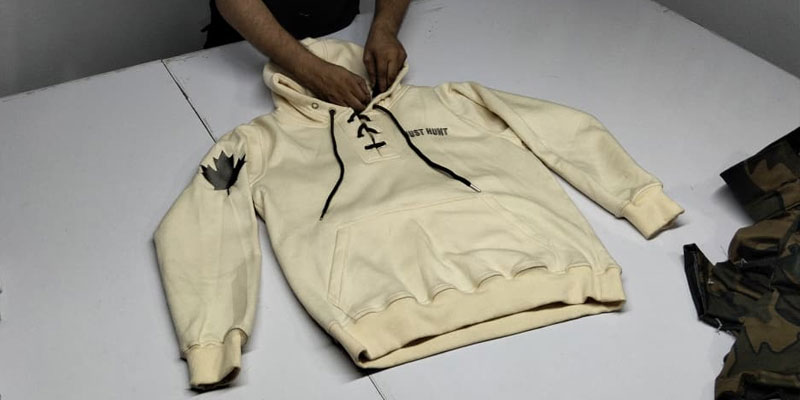
Most “cost to start a clothing brand” articles are written by people who have never run a cutting table.

They give you a vague range, a stock photo, and a pitch.

This one is different. Gibben Clothing is a cut-and-sew streetwear manufacturer. We quote, sample, cut, sew, decorate, and ship streetwear every week. So we pulled apart our own cost model and laid it out in full.

The goal is simple: give you the real numbers, so you can budget without blind spots.

We will walk the entire cost stack, then run one heavyweight hoodie through it at 50, 300, and 1,000 units so you can see exactly where the money goes and why your first small batch feels so painfully expensive per piece.

Then we cover the costs almost every first-time founder forgets, show where retail margin actually comes from, and hand you a cost-planning template you can copy.

All figures below are illustrative of a mid-spec custom hoodie program and are meant to teach the structure of cost, not quote your project. Your real numbers move with fabric weight, decoration, destination, and the month you ship. Ask us for a costed quote on your actual spec.

The short version

Nine findings, before you read the rest

If you only have two minutes, these are the things that surprise founders most.

  1. Quantity is the single biggest lever. The same hoodie costs roughly 2.7× more per unit at 50 pieces than at 1,000, driven almost entirely by fixed setup costs.

  2. Labor, not fabric, is often the largest line. At small runs, cut-make-trim can be your highest single cost because setup is spread over so few garments.

  3. Sampling is a fixed cost in disguise. Spread over 50 units, it can add several dollars per piece. Spread over 1,000, it nearly vanishes.

  4. Fabric is sold in dye-lot minimums. You often pay for more fabric than you use, per color, whether you order 50 hoodies or 250.

  5. Decoration setup is per design, not per garment. Screens, digitizing, and strike-offs are paid once so they punish small orders hardest.

  6. Duty in 2026 is a moving target. Cotton sweatshirts carry a base rate near 16.5%, with an extra baseline tariff stacked through mid-2026 and more under review. Budget a band, not a number.

  7. The $800 duty-free parcel loophole is gone. Small shipments that once slipped in under the de minimis now owe duty and need a formal entry.

  8. Freight per unit collapses with volume. A full container spreads ocean freight across thousands of pieces; a courier sample costs more to ship than to make.

  9. Your headline margin is not your real margin. Returns, discounts, fees, and overhead routinely eat 30–50% of gross. Price up from landed cost, never down from a sticker price.

The anatomy of a garment’s cost

The full cost stack

Every finished, delivered garment is built from seven cost layers. Skip one in your budget and your margin quietly disappears. Here they are, in the order the money leaves your account.

One landed hoodie, broken into layers

From yarn to your warehouse


01 Fabrics

Knitted, dyed, finished, and sold by the kilo, in lot minimums


02 Cut-make-trim (CMT)

The labour: cutting, sewing, finishing


03 Trims & Labels

Drawcords, eyelets, neck & care labels, hangtags, polybag


04 Decoration

Embroidery, screen print, patches, plus one-time setup


05 Sampling

Fit and color approval rounds, lab dips, and a fixed pre-cost


06 Freight

Factory to your warehouse: sea, air, or courier


07 Duties & clearance

Import tariff, broker, port and entry fees


= Your true landed cost per unit  the only number that matters

The trap is thinking only about the first two layers. Founders price against “The factory said $14 a unit” and forget that trims, decoration setup, sampling, freight, and duty can add 40% or more on top before a single hoodie reaches a customer.

Let’s take each layer in turn.

Layer 1 Fabric

Fabric is usually the largest material cost and the most likely to have hidden traps.

For a hoodie, you are buying knitted fabric, typically French terry or fleece, priced by the kilogram, already dyed and finished.

A mid-weight to heavyweight hoodie (say, 350–400 GSM) uses roughly 0.8 to 1.0 kg of fabric per garment once you account for cutting waste.

So if your knitted, dyed terry costs around $6 per kilo, your fabric cost per hoodie sits near $5–6 at volume.

Three things push it up:

  • Dye-lot minimums. Fabric is dyed in batches. Each color has a minimum, often 100–300 kg per color. Order below it, and you either pay a surcharge or pay for fabric you won’t use.
  • Weight and blend. Heavier GSM means more kilos per garment. Premium cotton, organic, or recycled blends cost more per kilo. A 500 GSM organic terry is a different animal from a 280 GSM poly-cotton.
  • Small-lot pricing. Buying a little fabric costs more per kilo than buying a lot. Mills reward volume.

First-hand note

In our own production, fabric is where small orders bleed the most quietly. A founder ordering 50 hoodies in three colors is buying three dye lots and rarely using a full lot of any of them.

Want to learn more about fabric sourcing? Here is our fabric sourcing guide

Layer 2 Cut-make-trim (CMT)

CMT is the labor to turn fabric into a finished garment: cutting the panels, sewing them, attaching ribbing, setting the hood, and finishing.

It is quoted per unit, but it hides a large fixed component.

Before a single hoodie is sewn, the factory makes a pattern, grades it across sizes, creates a marker for cutting, and sets up the line. Those costs are the same whether you make 50 hoodies or 1,000.

So CMT per unit looks roughly like this: high at tiny runs because setup has nothing to spread over, then falling sharply and flattening out once you are into the hundreds.

A hoodie is a relatively complex garment with a hood, pocket, ribbing, and drawcord channel, so its CMT sits above a plain tee.

Why complexity costs

Every extra operation a kangaroo pocket, contrast ribbing, a zip, a double-layer hood adds sewing time. Streetwear’s love of detail is exactly what makes it more expensive to make than basics.

Want to learn more about CMT and FOB? Here is our CMT & FOB guide

Layer 3 Trims & Labels

Trims are everything that isn’t the main fabric: drawcords and tips, metal eyelets, woven neck labels, printed care labels, hangtags, size stickers, sewing thread, and the polybag each garment ships in.

Individually, they’re cents. Together they add up, and like fabric, they come with minimums. A custom woven label might have a minimum order of 500 or 1,000 pieces, so a 50-unit run pays for labels it won’t use or pays a surcharge for a short run.

Branded, custom trims (your own drawcord tips, a custom metal zip puller, and a leather-look patch) raise both the unit cost and the minimums. This is a common place where a brand’s “elevated” look quietly doubles the trim bill.

Want to learn more about trims? Here is our Trims guide

Layer 4 Decoration

Decoration is your artwork on the garment: embroidery, screen printing, puff print, DTG, patches, and appliqué. It has two parts, and confusing them is a classic budgeting error.

Setup (one-time, per design): digitizing an embroidery file, burning screens for each ink color, and making a strike-off or sample to approve. You pay this once, no matter the quantity.

Run cost (per garment): the actual stitching or printing on each piece. This scales with quantity and with complexity; more ink colors or more stitches cost more per unit.

Because setup is fixed, decoration is brutal on small orders. A six-color screen print might carry meaningful screen-setup costs spread over only 50 shirts. The same setup for over 1,000 shirts is trivial per unit.

Design choice = cost choice

A large back print with seven colors and a puff front and chest embroidery is three setups and three run costs. Every placement is its own little cost stack. Simplify the artwork and your unit cost drops fast.

Check out our full decoration guide

Layer 5 Sampling

Before bulk production, you approve samples. This is non-negotiable, and it is a real cost that founders routinely leave out of their budget.

A sample is a one-off: the factory makes a single garment by hand, sets up decoration for one piece, and usually runs two or three rounds: a first proto, a fit correction, and a pre-production sample, plus lab dips to approve each color. Add courier costs to ship samples back and forth.

Treat sampling as a fixed pre-production cost. Spread over a 50-unit run, it can add several dollars to every garment. Spread over 1,000, it’s a rounding error. That single fact reshapes whether a small first run makes sense.

Budget tip

Sampling is paid upfront, weeks before production. Plan the cash for it separately. A realistic sampling budget for a single hoodie style with decoration and color approvals is a few hundred dollars before you’ve made a single sellable unit.

Complete rule book for Golden Sample

Layer 6 Freight

Getting goods from the factory to your warehouse is its own cost, and it swings wildly with order size and shipping mode.

  • Sea (FCL / LCL): cheapest per unit, slowest. A full container spreads freight across thousands of garments, so per-unit ocean freight on a large order can be around a dollar or less.
  • Air: fast, far more expensive per kilo. Useful for urgent reorders, painful as a default.
  • Courier (DHL/FedEx): what you use for samples and tiny orders. Per-unit, it’s the most expensive way to move garments; a courier sample can cost more to ship than to make.

2026 adds a twist: ocean rates have been volatile. Capacity is abundant, which pushes spot rates down, but Red Sea diversions and peak-season surcharges keep pushing them back up. Through 2026, benchmark container indices have swung by double-digit percentages month to month. The lesson isn’t a number; it’s to quote freight close to the ship date and build a buffer for surcharges (peak-season, fuel, and general rate increases).

Incoterms matter here. An “FOB factory” price excludes freight and duty; a “DDP” price includes them. Compare quotes on the same terms, or you’ll compare the wrong numbers.

Layer 7 Duties & Clearance

This is the layer that changed the most going into 2026 and the one most likely to wreck a budget built on old assumptions.

Import duty is a percentage charged on the customs value of your goods when they enter the destination country. For apparel, it’s based on the product’s tariff classification (HTS code) and the country of origin.

For the US market, most streetwear founders target the picture in 2026 looks like this:

  • Base rate. Cotton sweatshirts and hoodies have long carried a base (MFN) duty around 16.5%. That part is stable.
  • Stacked surcharges. Through mid-2026, an additional baseline tariff has been stacked on top of the base rate after courts struck down an earlier round and the administration replaced it. Further country-specific actions are under review, with a key temporary measure set to expire in late July 2026.
  • De minimis is gone. The old rule that let parcels under $800 enter duty-free has been suspended. Small shipments now owe duty and need a formal customs entry.
  • Clearance costs. On top of duty itself: customs brokerage, a customs bond, port and handling fees, and possible exam charges.

Do this, not that

Don’t hard-code a duty rate from an article including this one. The rate that applies the day your container lands depends on your exact HTS code, country of origin, and whatever policy is live that month. Get the current number from a licensed customs broker before you finalise pricing.

For the worked example below, we apply an illustrative blended duty of about 25% so you can see how it flows through the math. Treat that as a placeholder, not a forecast.

Learn more about customs duties here.

The whole stack, run for real

Worked example: one hoodie at 50 vs 300 vs 1,000 units

Here is the entire cost stack applied to a single garment: a custom heavyweight pullover hoodie, around 380 GSM cotton-rich French terry, with a chest embroidery and a one-color back print made in Sialkot and landed at a US warehouse.

Watch what quantity does.

Cost layer (per unit) 50 units 300 units 1,000 units
Fabric $8.50 $6.20 $5.50
Cut-make-trim $11.00 $6.00 $4.50
Trims & labels $4.00 $2.40 $1.80
Decoration $5.50 $2.80 $2.00
Sampling (amortized) $7.00 $1.15 $0.35
FOB subtotal (ex-works) $36.00 $18.55 $14.15
Freight (per unit) $6.00 $2.50 $1.20
Duty (illustrative ~25%) $9.00 $4.65 $3.55
Landed cost per unit $51.00 $25.70 $18.90

Want to get real figures? Contact us so we can prepare a dedicated quote

The story is in three lines:

  • At 50 units, you land each hoodie at about $51. Setup costs have almost nothing to spread over, so they dominate.
  • At 300 units, you’re at roughly $26, about half because sampling, cutting, and decoration setup are now shared across far more pieces.
  • At 1,000 units, you’re near $19, and the curve is flattening. From here, further savings are smaller and come mostly from fabric and labor rate, not setup.

The takeaway

Your first small batch isn’t expensive because the factory is gouging you. It’s expensive because you’re paying full setup costs across a handful of units. Scale doesn’t just lower cost it changes which costs matter.

Want this run on your actual spec, fabric, and destination? Send us your tech pack for a costed quote.

You can explore our other guides on Small Batch vs. Bulk Batch Production and Why Streetwear Costs Less When You Order More

The invoice surprises

Hidden costs founders forget

These rarely appear in a headline quote, but they’re real money. Budget for them now, not when the email arrives.

Fabric

Dye-lot minimums

Each color is dyed in a minimum batch. Order under it and you pay for fabric you don’t use multiplied by every color in your range.

Money

Payment & FX costs

Wire fees, letter-of-credit costs, and currency conversion quietly shave a percent or two off every payment you send overseas.

Trims

Trim & label minimums

Custom woven labels, drawcords, and tags carry their own MOQs, often in the hundreds or thousands, regardless of how many garments you make.

Freight

Surcharges on top of freight

Peak-season surcharges, fuel (bunker) surcharges, and general rate increases can stack hundreds of dollars onto a container quote after you thought it was fixed.

Customs

Brokerage, bond & port fees

Duty isn’t the only border cost. A customs broker, a customs bond, terminal handling, and possible exam fees all sit on top of the tariff itself.

Quality

Defect & seconds allowance

No run is 100% perfect. A small percentage will fail inspection. Plan a defect allowance so your sellable quantity matches your real quantity.

Color

Lab dips & strike-offs

Approving a color means dyeing test swatches (lab dips); approving a print means a printed strike-off. Each round costs money and time, and most colors take more than one round.

Cash

The reorder gap

You pay deposits and balances months before goods sell. Your capital is tied up across the whole cycle, and you’ll often need to fund a reorder before the first run is fully sold.

Quality control is its own discipline. See our deep dive on hoodie quality control & AQL inspection for how defect rates are actually measured.

Where the money comes back

Where your retail margin actually comes from

Knowing your landed cost is half the job. The other half is pricing so the brand survives. Here’s the math, and the trap inside it.

The standard multiples

Two common pricing approaches:

  • Direct-to-consumer (DTC): price retail at roughly 4–5× landed cost. Land at $19, retail near $85–95.
  • Wholesale: sell to stockists at about 2× landed, and they mark up about 2× again (keystone) to the shopper.

Using our 1,000-unit landed cost of about $19, a DTC retail of $89 looks like a fat 79% gross margin. It is not. Watch what really happens to that gross.

Your real margin (the waterfall)

Retail price (DTC)                                                                    $89.00


– Landed cost per unit                                                           –$18.90


= Gross profit                                                                          $70.10


– Returns & exchanges (~15%)                                              –$13.35


– Discounts & promos (~10%)                                               –$8.90


– Payment & platform fees (~4%                                           –$3.56


– Marketing / customer acquisition                                       –$18.00


– Pick, pack & fulfilment                                                        –$5.00


≈ True contribution per unit                                                  $21.29

The “79% margin” becomes a roughly 24% contribution once the real costs of selling are counted and that’s before rent, salaries, and software. Those figures are illustrative; the point is the shape, not the decimals.

The rule

Price up from your landed cost with a target contribution in mind. Never pick a sticker price first and hope the margin works out. The brands that fail almost always are priced down from a number they liked the look of.

Why wholesale changes the math

Sell wholesale, and you trade margin for volume and reach. At, say, $42 wholesale on a $19 landed cost, your gross per unit is about $23 lower than the DTC headline, but you’re not paying marketing or fulfillment per unit, and you move quantity. Most growing streetwear brands run both channels and accept that each has a different margin profile.

Build your own number

A simple cost-planning template

Copy this into a spreadsheet. Fill the right column with quotes from your factory and freight forwarder and a current duty rate from your broker. The structure is the value; it stops you from forgetting a layer.

Line item How to fill it Your number
Order quantity Units per style/colour   _____
Fabric/unit kg per garment × $/kg (mind dye minimums) $_____
Cut-make-trim / unit Factory CMT quote at your quantity $_____
Trims & labels/unit Sum of cords, labels, tags, polybag $_____
Decoration/unit Run cost per placement $_____
Decoration setup (total) Screens/digitizing/strike-offs ÷ units $_____
Sampling (total) All sample rounds + lab dips ÷ units $_____
= FOB cost/unit Sum of the above $_____
Freight/unit Quote ÷ units (add surcharge buffer) $_____
Duty/unit Live rate × customs value (ask broker) $_____
Clearance/unit Broker + bond + port fees ÷ units $_____
= LANDED cost/unit Your true cost price up from here $_____
Target contribution What each unit must clear after selling costs $_____
Indicative retail Landed × 4–5 (DTC) or via wholesale math $_____

Want this as a ready-made spreadsheet with the formulas built in? Grab the Gibben Clothing cost-planning template.

Frequently asked questions

It depends almost entirely on quantity. In our illustrative 2026 model, a custom heavyweight pullover hoodie lands at about $51 per unit at 50 pieces, ~$26 at 300, and ~$19 at 1,000 delivered to a US warehouse with freight and duty included. The per-unit cost falls because setup costs (sampling, cutting, decoration screens, dye minimums) get spread across more units.

Most cut-and-sew factories sit around 50–100 units per style and color, mainly because fabric is dyed in minimum lots. Lower MOQs exist via stock fabric or blank-decoration routes, but true custom cut-and-sew, with your own fabric, fit, and trims — only becomes cost-efficient from a few hundred units up.

A sample is a one-off production run. The factory makes a single garment by hand, sets up decoration for one piece, and usually runs two or three rounds plus lab dips for color. Those are fixed costs with nothing to spread them over, so a sample costing $80–150 is normal even when the bulk unit price is far lower.

2026 duty is unusually volatile. Cotton sweatshirts carry a base (MFN) rate around 16.5%, with a temporary additional baseline tariff stacked on top through mid-2026 and further country-specific actions under review. The $800 de minimis parcel exemption has been suspended. Always confirm the live rate for your exact HTS code and country of origin with a customs broker before costing a shipment.

A common target is 4–5× landed cost for DTC, or roughly 2× landed to wholesale and 2× again to retail. But the headline margin isn’t your real margin returns; discounts, fees, marketing, and overhead routinely consume 30–50% of gross. Price up from landed cost with a target contribution, never down from a sticker price.

Cash usually leaves months before it returns: sampling, deposits, production, freight, and duty are paid before the first unit sells. Many founders need two or three sell-through cycles before the brand funds its own reorders. Plan working capital for at least one full production cycle plus a reorder, not just the first run.

From the manual

This is one chapter of The Complete Streetwear Manufacturing Guide

These chapters cover taking a streetwear brand from idea to shipped units, costing, sourcing, tech packs, QC, freight, and launch. All written from the Sialkot factory floor.

Open The Full Guide

Methodology & sources

The cost stack and worked example reflect the cost structure GIBBEN CLOTHING uses in day-to-day cut-and-sew production. Per-unit figures are illustrative of a ~380 GSM cotton-rich pullover hoodie with chest embroidery and a one-color back print made in Sialkot and landed in the US and are presented to demonstrate how cost behaves with quantity rather than to quote any specific project.

External market context, 2026 US apparel tariff conditions, the suspension of the $800 de minimis exemption, and ocean-freight rate volatility are drawn from publicly reported industry and trade sources. Tariff policy in 2026 is actively changing; readers should confirm current rates for their own HTS classification and country of origin with a licensed customs broker.

Fashion Industry Association (USFIA) and Dr. Sheng Lu / University of Delaware apparel tariff tracking; American Apparel & Footwear Association (AAFA) tariff resources; Drewry World Container Index and Freightos Baltic Index for 2026 ocean-freight benchmarks. Add live outbound links to these in production.

Figures illustrative · Not financial advice. We’re a manufacturer, not a financial advisor; use this to budget and confirm tax, duty, and pricing decisions with qualified professionals.