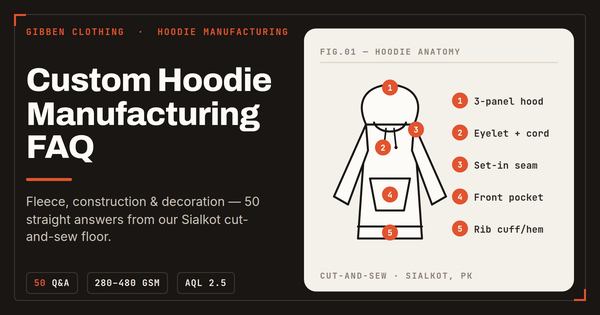

Most hoodie advice is written by people who never stood at a cutting table:

This is the opposite. Every chapter here comes out of running real cut-and-sew hoodie production in Sialkot: the samples that failed, the GSM that made sense, the seam that twisted after the first wash, and the QC calls that saved a drop.
It’s built as a manual, front to back. Styles and fabric come first, then decoration, construction, and costing.

From there it moves into the working detail finishing, sourcing, style-specific production, QC, and logistics and closes with trends, real case studies, and a full reference section. Read it in order, or jump straight to the chapter you need.

Every guide below is a full walkthrough of one decision.

How to use this guide?

01: New to hoodies? Start with Styles & Silhouettes, then Fabric & GSM. Those two decide most of the garment.


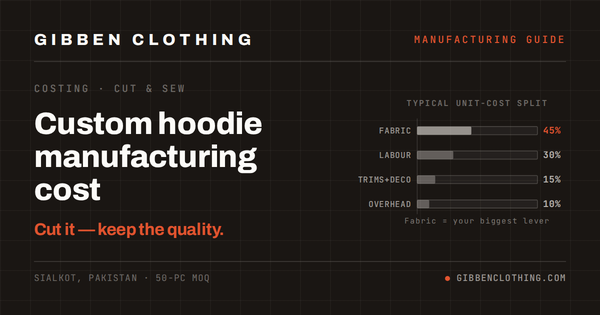
02: Costing a run? Jump to Costing, MOQ & Sourcing, and read a quote line by line before you reply to any factory.


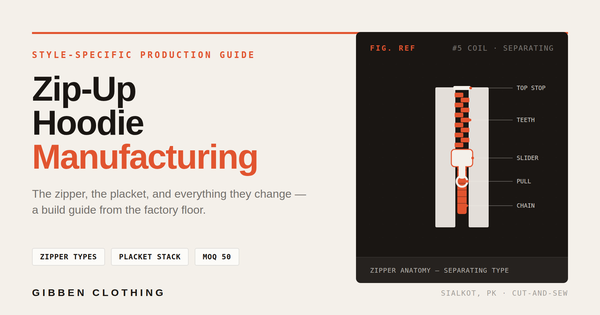
03: Know your style already? Go to the Style-Specific Production Guides, one silhouette, cut to shipped.


04: Fixing a problem? QC & Defect Troubleshooting names the cause and the prevention for each failure.

Hoodie manufacturing, quick answers

Every guide here comes out of our own cut-and-sew floor in Sialkot, Pakistan.

We run the sampling, the sewing, and the QC in-house rather than brokering it out, which is why the advice is about what happens on real machines, not what a catalogue says.

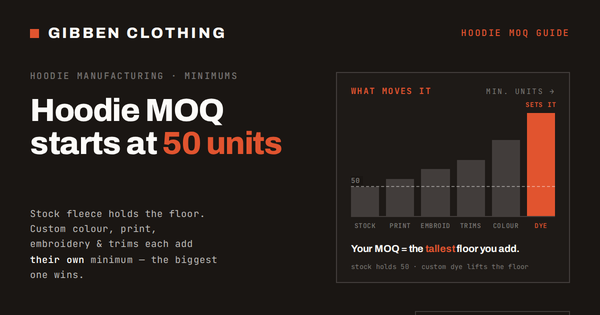
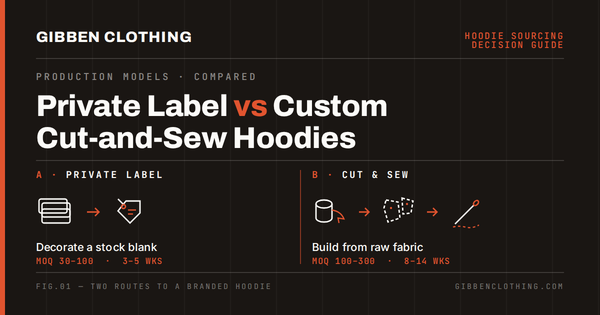
It depends on the fabric, the number of colors, and the decoration, which is exactly why MOQ gets its own chapter.

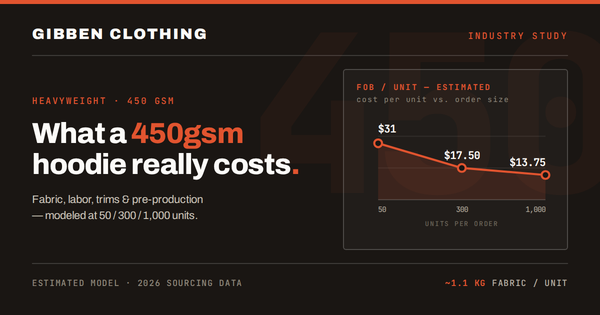
As a starting point, our low-MOQ program runs from 50: MOQ units units per style, and the MOQ guide explains how each choice moves that number.

Yes. Heavyweight is a large part of what we make, and it changes the pattern, the sewing time, and the cost the heavyweight guides walk through exactly what that involves and what it should cost.

Yes. The tech pack chapter includes a field-by-field walkthrough and a filled example, and our sampling process is built to develop a garment from a sketch or a reference if you don’t have full specs yet.

From approved sample to shippable units, expect a realistic window rather than a single-number fabric lead time, decoration and QC all sit inside it. The lead-time chapter breaks the timeline down stage by stage.

On the floor · Sialkot

Written by

Faizan Ahmad

Chief Apparel Technologist & Head of Manufacturing, Gibben Clothing · Sialkot, Pakistan

Faizan leads production at Gibben Clothing, a cut-and-sew streetwear manufacturer in Sialkot, with 8+ years turning raw yarn into retail-ready hoodies, tees, bottoms, jackets, tracksuits, and headwear. He doesn’t just write about clothing; he works the floor, so every guide here is grounded in real fabric behavior, QC standards, and production data from live runs.